In 1914, a Canadian army vet named Harry Colebourn bought a black bear cub in White River, Ontario, on his way to the First World War. He named her after his home town, Winnipeg. On 9 December 1914, he left "Winnie" at London Zoo, where a small boy called Christopher Robin Milne fell in love with her. His father, A. A. Milne, turned her into Winnie-the-Pooh, the world's most famous honey lover [1].
More than a century later, Prairie honey still makes the trip to Britain. Only now it travels with an invoice, a booking number and a set of border rules.
This article follows two example orders from start to finish. One goes by sea, one by air. Both are typical of the shipments Nature Shire handles for Canadian food and beverage brands: what gets checked, which papers travel with the goods, what the importing country asks for, and how long it really takes.
The two orders are illustrative examples. Timings are typical ranges, not guarantees; they depend on season, carrier space and border checks.
Journey 1: Prairie buckwheat honey to the UK, by sea
The order. A UK food manufacturer orders two 300 kg drums of Canadian buckwheat honey, 600 kg in total, from a Prairie packer. Dark, strong buckwheat honey is prized by bakers and specialty brands.
Step 1: Agree the deal. Before anything moves, both sides agree:
- Specification: honey type, colour, moisture, and the tests the buyer wants to see.
- Price and Incoterms: for example, CIF Felixstowe (Incoterms 2020), meaning the seller pays freight and insurance to the UK port.
- Payment terms: for a first order, often a deposit with the balance against shipping documents.
- A pro forma invoice confirms it all in writing.
Step 2: Check the honey can enter the UK. Canadian honey is classed by the UK as a low-risk product of animal origin. Since 30 April 2024, Canadian honey no longer needs a CFIA-issued health certificate to go to Great Britain [2]. Canada must be on the UK's list of countries approved to export honey, and the honey must come from a producer registered with the Canadian authorities [4]. It must not be blended with honey from origins the UK has not assessed [2]. (Northern Ireland follows EU rules, which are different [2].)
Step 3: Test, pack and label. The packer draws samples for a certificate of analysis (typically moisture, colour and residue screening, to the buyer's specification). The drums are food-grade, sealed and labelled with product name, lot number, net weight and Canada as country of origin. Both drums are strapped to one heat-treated pallet marked to the ISPM 15 standard, which the UK requires for wooden packaging.
Step 4: Book the freight. Two drums do not fill a container, so they travel as LCL (less than container load): the pallet shares a container with other shippers' goods. The freight forwarder books space from a consolidation warehouse in Montreal, and the pallet goes by truck or rail from the Prairies to Montreal.
Step 5: The papers.
| Document | Who prepares it | Why it matters |
|---|---|---|
| Commercial invoice with origin declaration | Exporter | Value for customs; the origin statement claims zero duty under the Canada–UK Trade Continuity Agreement [5] |
| Packing list | Exporter | Drum weights, lot numbers, pallet details |
| Bill of lading | Freight forwarder | Contract of carriage and title to the goods |
| Commercial document for low-risk animal products | Supplier | Required by the UK for low-risk products such as honey [2][3] |
| Certificate of analysis | Packer or lab | Proves the honey meets the buyer's specification |
| Insurance certificate | Seller (under CIF) | Covers the goods at sea |
| Canadian export declaration (CERS) | Exporter or broker | Filed with the Canada Border Services Agency for commercial exports outside the US above C$2,000 |
The origin declaration is a short statement on the invoice. It carries the Canadian exporter's CRA business number and confirms the honey is of Canadian preferential origin. No separate certificate is needed [5].
Step 6: Arrival in the UK. At least one working day before the ship arrives, the UK importer pre-notifies the consignment on the government's IPAFFS system [3]. The honey enters through a border control post designated for animal products. As a low-risk product, it does not face routine document, identity or physical checks, although officials can check it if they see a risk [2]. The importer's customs broker files the import declaration, duty is zero with the origin statement, and UK VAT still applies [5]. The pallet is unloaded at the port warehouse and trucked to the buyer.
How long it takes: about 5 to 8 weeks from signed order to delivery, of which 2 to 3 weeks are at sea and in port. See the timeline below.
Journey 2: Okanagan cherries to South Korea, by air
The order. A Seoul fruit importer orders fresh sweet cherries from a Kelowna packer in August, when late-season Okanagan cherries reach the market after most other North American harvests have finished [6].
Step 1: The work done before the season. Fresh fruit cannot be exported on a whim. BC cherries gained access to South Korea only in August 2022, after seven years of talks between Canadian and Korean plant-health officials [6]. Exporters must follow the agreed rules: in Korea's protocols, orchards and packhouses are registered and approved for the Korean market, pests are monitored, and Korea's food authorities register foreign food facilities [7]. The first BC shipments to Korea came from packers who set up pest-monitoring procedures to meet these requirements [8]. All of this is in place months before harvest.
Step 2: Confirm the order and the flight. Price, carton size, grade and Incoterms are agreed, for example CPT Incheon. The forwarder books cargo space on a flight from Vancouver to Incheon days ahead, because peak-season belly space fills quickly.
Step 3: Pick, cool, pack, inspect. Cherries are picked in the cool morning, chilled within hours to near freezing, sorted and packed into cartons with liners that slow ripening. Cartons are marked with the registered orchard and packhouse details Korea requires [7]. A CFIA inspector checks the lot and issues a phytosanitary certificate, the plant-health passport stating the fruit meets Korea's conditions [7].
Step 4: Keep it cold. A refrigerated truck takes the pallets from Kelowna to Vancouver airport, about a four-to-five-hour drive. The cold chain must not break: every warm hour shortens shelf life.
Step 5: The papers.
| Document | Who prepares it | Why it matters |
|---|---|---|
| Commercial invoice with origin declaration | Exporter | Claims the preferential tariff under the Canada–Korea Free Trade Agreement [6] |
| Packing list | Exporter | Cartons, lots, registered orchard and packhouse numbers |
| Air waybill | Airline or forwarder | Contract of carriage |
| Phytosanitary certificate | CFIA | Required by Korea for fresh fruit [7] |
| Canadian export declaration (CERS) | Exporter or broker | Filed with the Canada Border Services Agency |
| Temperature records | Packer and carrier | Proof the cold chain held |
Step 6: Arrival in Korea. The flight takes about 11 hours. At Incheon, Korean plant-quarantine officers inspect samples for pests and check the phytosanitary certificate, and food-safety officials clear the shipment [7]. Under the Canada–Korea Free Trade Agreement, Korea's 24% tariff on Canadian cherries was scheduled to fall to zero by 2024 [6]. The importer collects the cherries and they can be on Seoul shelves within days of being picked.
How long it takes: about 1 to 2 weeks from order to delivery in season, with only 3 to 5 days from tree to Seoul. The registration work behind it takes months. See the timeline below.
Sea or air: how to choose
| Sea (honey) | Air (cherries) | |
|---|---|---|
| Best for | Shelf-stable goods, heavy loads | Perishable, high-value goods |
| Door-to-door time | 5–8 weeks | 3–5 days after picking |
| Cost per kilo | Low | High |
| Biggest risk | Delays at port, missing papers | Broken cold chain, lost flight space |
| Key certificate | Origin declaration; UK low-risk commercial document | CFIA phytosanitary certificate |
What it means for Canadian brands
- Paperwork is the product. A missing origin statement can cost the duty saving; a wrong certificate can stop a shipment at the border.
- Market access comes first. Some products can ship anywhere tomorrow; fresh fruit and meat often need years of government negotiation and registration before the first order.
- Timing is a sales tool. Late-season BC cherries and Prairie honey can fill gaps in other countries' calendars.
- Trade agreements pay. Canada's agreements with the UK and South Korea remove duties, but only if the paperwork claims them.
From Winnipeg to the world
Winnie the bear crossed the Atlantic with a soldier. Today's Canadian honey and cherries cross oceans with freight forwarders, inspectors and a stack of well-prepared documents. Get the paperwork right, and Canada's best food can reach almost any table in the world.
Nature Shire acts as the export arm for Canadian food and beverage brands, handling orders, documents, freight and buyer relationships from farm gate to foreign shelf. Follow us on X at @NatureShire for more stories from the food system.
Timelines
For the website, upload the image file export-timelines-honey-uk-cherries-korea.png just before the "Sea or air: how to choose" heading. The same picture is drawn here.
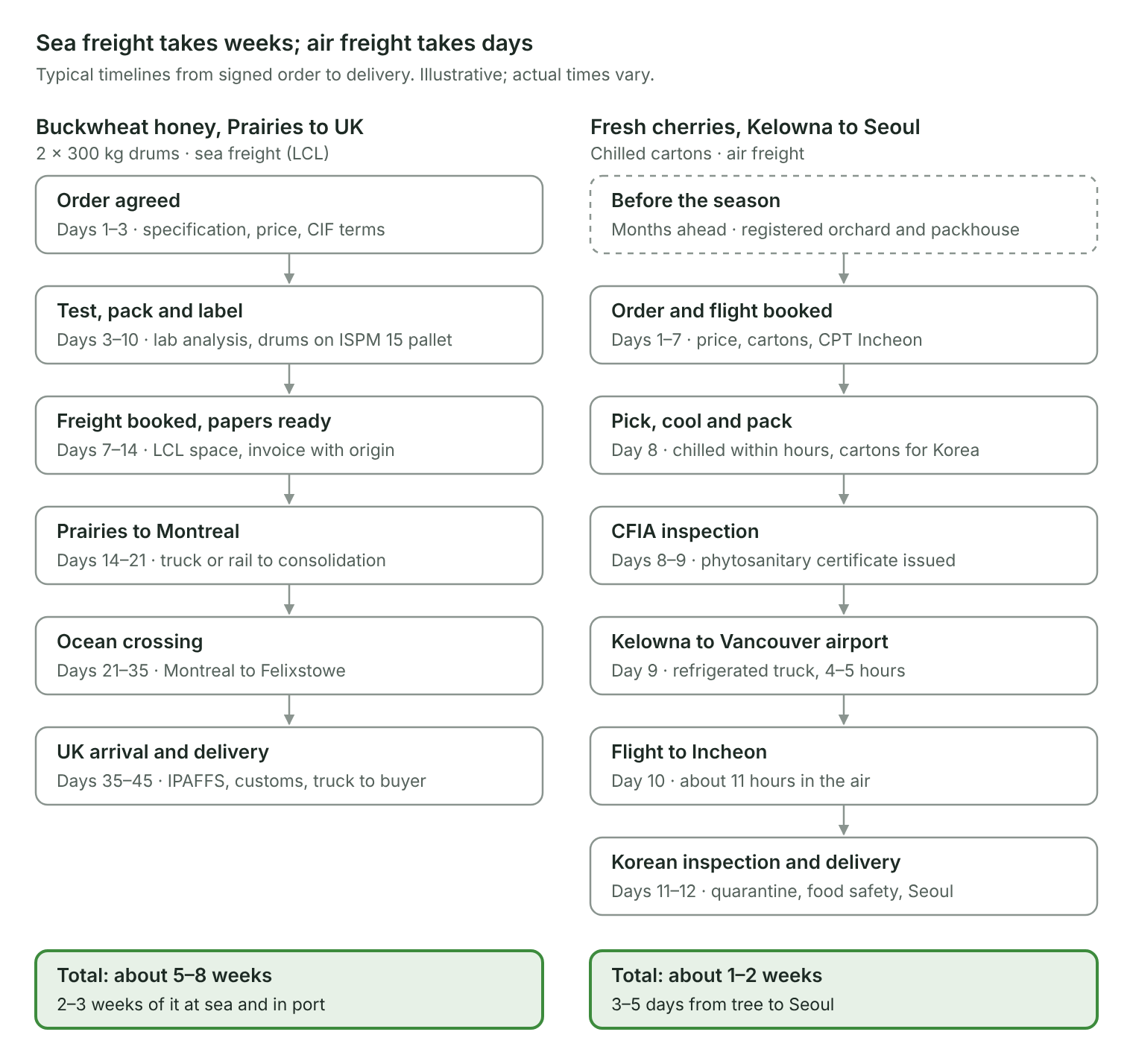
The honey spends most of its 5 to 8 weeks moving and waiting at port; the cherries rely on registration done before the season, then reach Seoul within days of picking.
References
- ZSL London Zoo, "The real story behind Winnie the Pooh." https://www.londonzoo.org/zoo-stories/history-of-london-zoo/famous-animals-london-zoo/winnie-pooh-origins
- Canadian Food Inspection Agency, "United Kingdom: honey and apiculture products" (export requirements). https://inspection.canada.ca/en/exporting-food-plants-animals/food-exports/requirements/united-kingdom-honey-and-apiculture-products
- Dover Port Health Authority, "Products of animal origin" (import guidance). https://www.doverporthealth.gov.uk/import-guidance/products-of-animal-origin/products-of-animal-origin
- GOV.UK, "Import of honey, royal jelly and other apiculture products for human consumption (IIN BAL/2B)." https://www.gov.uk/government/publications/other-animal-products-for-human-consumption-import-information-notes/import-of-honey-royal-jelly-and-other-apiculture-products-for-human-consumption-import-information-note-iin-bal2b
- FedEx, "UK and Canada free trade agreement" (origin declaration guidance). https://www.fedex.com/en-gb/customs-tools/free-trade-agreements/uk-and-canada.html
- Agriculture and Agri-Food Canada, "Government of Canada expands market for fresh British Columbia cherries to South Korea" (10 August 2022). https://www.canada.ca/en/agriculture-agri-food/news/2022/08/government-of-canada-expands-market-for-fresh-british-columbia-cherries-to-south-korea.html
- Australian Government, MICoR Plants, "Korea, Republic of: cherries" (Korea's import protocol, shown as an example of its requirements). https://micor.agriculture.gov.au/plants/korea%2C_republic_of_kr/cherries
- Fruitnet Asiafruit, "First BC cherries bound for Korea." https://www.fruitnet.com/asiafruit/first-bc-cherries-bound-for-korea/247027.article