In 2014, Red Bull agreed to pay US$13 million to settle a US class action that said its drink was no better than a cup of coffee, despite advertising that promised to "give you wings." Anyone who had bought a can since 2002 could claim US$10 in cash or US$15 in Red Bull products [1]. The company denied any wrongdoing and said it settled to avoid the cost of a fight [1].
That lawsuit was a very modern argument about a very old business. People have been selling bottled energy, and arguing about what was in the bottle, for more than 160 years. The story runs from a French wine endorsed by a Pope, to an Atlanta pharmacy, to a Bangkok truck stop, to a Canadian recall.
1863: the Pope's favourite tonic
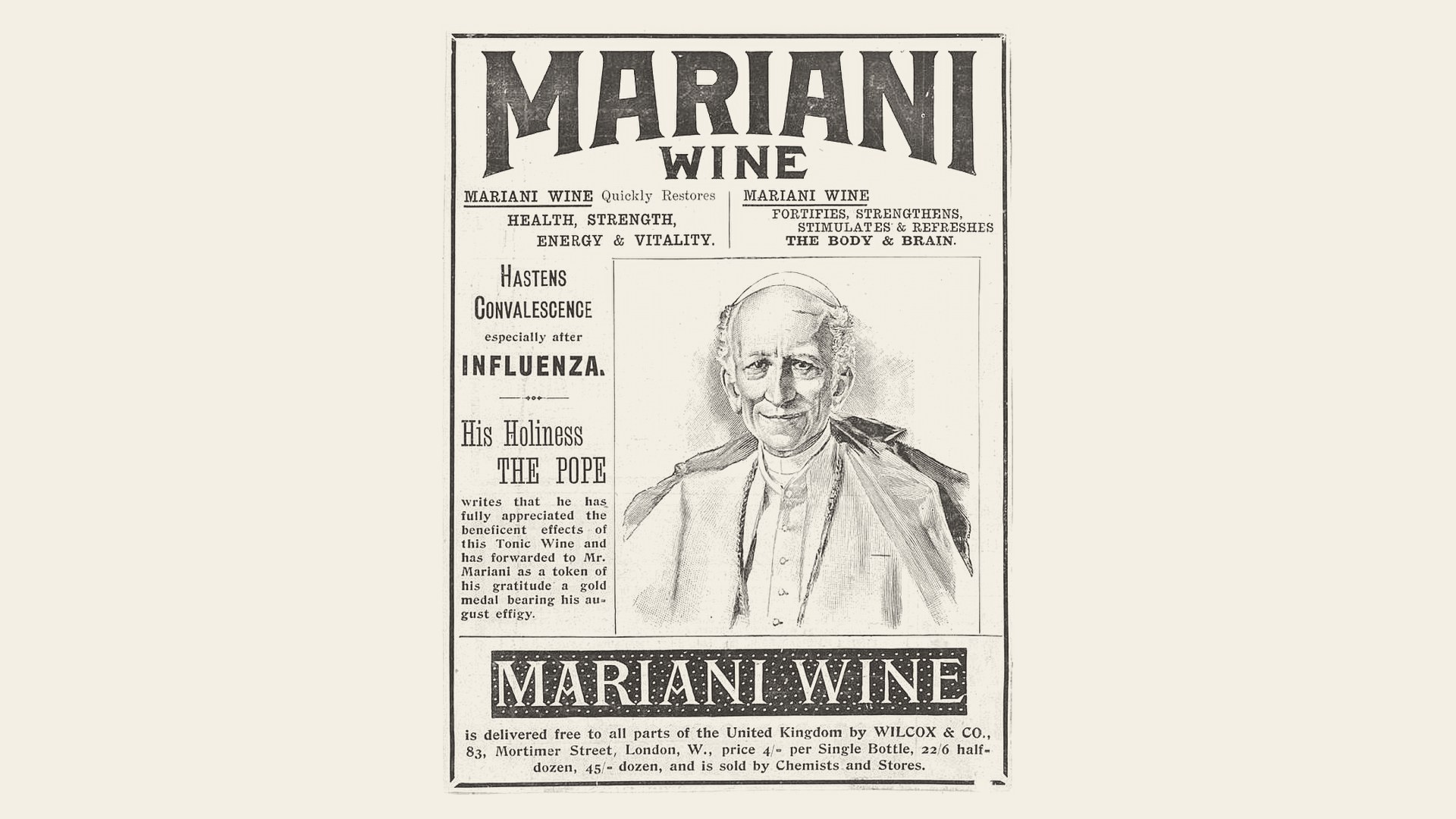
In 1863, a Corsican chemist named Angelo Mariani launched Vin Mariani, a Bordeaux wine infused with coca leaves [2]. It was sold as a cure-all, and the endorsements were extraordinary. Pope Leo XIII reportedly sent Mariani a gold medal bearing his image, Queen Victoria was said to be a user, and actress Sarah Bernhardt appeared in its adverts [2].
It was, in effect, the world's first celebrity-endorsed energy drink.
1886: Atlanta goes dry, Coca-Cola is born
Across the Atlantic, Atlanta pharmacist John Pemberton made his own imitation, French Wine Coca [2][3]. Then Atlanta voted for prohibition in 1885 [3]. Pemberton took out the wine, mixed the coca extract with sugar syrup and carbonated water, and in 1886 Coca-Cola was born [3][4]. His bookkeeper, Frank Robinson, came up with the name and the script logo [3].
The early drink contained a significant dose of cocaine. Most of it was removed in 1903, and the rest by 1929 [4]. Pemberton sold his rights in 1888 for US$1,750 and died the same year [3]. He never saw what his "temperance drink" became.
It is a neat irony: a temperance law meant to take the buzz out of drinking ended up creating the world's most famous soft drink.
1976–1987: from Thai truckers to Formula 1
The modern energy drink was born in Thailand. In 1976, Chaleo Yoovidhya launched Krating Daeng, meaning "red gaur," a sweet caffeinated tonic popular with truck drivers and labourers [5].
In 1982, an Austrian working for the German company Blendax, Dietrich Mateschitz, visited Thailand and found the drink cured his jet lag [5]. He and Chaleo each put in US$500,000 and founded Red Bull GmbH in 1984. The drink launched in Austria on 1 April 1987 [5]. In 2025, Red Bull sold more than 13.9 billion cans, and the Yoovidhya family still controls 51% of the company [5].
A tonic for Bangkok's night drivers became a global brand by selling a feeling, not a flavour: speed, extreme sports and wings.
2023: Canada says no to Prime
Canada regulates energy drinks more tightly than many countries. Caffeinated energy drinks here can contain at most 180 mg of caffeine per serving. They must carry cautionary statements and are not recommended for children under 14 or for pregnant or breastfeeding people [6]. Adults are advised to keep their total caffeine to 400 mg a day [6].
In July 2023, the Canadian Food Inspection Agency recalled Prime Energy, the drink co-founded by YouTube stars Logan Paul and KSI. It contained 200 mg of caffeine per can, over the limit [7]. Five other brands were recalled at the same time, and all six were cited for labels that were not in both English and French [7].
For brands, the lesson is simple: a product that is a hit on TikTok can still be pulled from Canadian shelves if it is not built for Canadian rules.
The next buzz: "natural energy"
The newest trend goes back to the oldest sources. Yerba mate was first cultivated and drunk by the Guaraní people of what is now Paraguay. In the mid-1600s, Jesuit missionaries learned to grow it on plantations [8]. Today Brazil, Argentina and Paraguay produce almost all of it [8]. Mate, green tea, guayusa and guarana all contain natural caffeine, and drinks built on them are marketed as "cleaner" energy than synthetic caffeine and sugar.
It is the same promise Vin Mariani made in 1863, with better labelling.
What it means for buyers
- Check the caffeine against each market. Canada's limit is 180 mg per serving [6]. A can that is legal in the US may not be legal here.
- Bilingual labels are not optional. In Canada, missing French was one of the reasons six brands were recalled together [7].
- Back up the claims. "Better than coffee" and "gives you wings" both cost Red Bull money in court [1]. Performance claims need evidence.
- Look at natural caffeine. Mate, green tea and guarana let brands tell an origin story, which buyers in North America and Europe increasingly want.
Wings not included
From a Pope's medal to a Thai trucker's tonic to a recall notice in Ottawa, energy drinks have always sold a promise. The products that last are the ones whose labels can survive a lawyer, a regulator and a sceptical customer.
Nature Shire helps Canadian food and beverage brands reach buyers worldwide. Follow us on X at @NatureShire for more stories from the food system.
References
- NBC News, Red Bull drinkers can claim $10 over "gives you wings" lawsuit (October 2014).
- VinePair, Vin Mariani: the Bordeaux wine with coca.
- Lemelson-MIT Program, John Pemberton.
- Live Science, Does Coca-Cola contain cocaine?
- Wikipedia, Red Bull.
- Government of Canada, Caffeinated energy drinks: what you should know (public advisory, updated 29 April 2026).
- Canadian Grocer, Popular Prime drink and five others that exceed Health Canada's caffeine limits recalled (12 July 2023).
- Wikipedia, Yerba mate.
Banner image: Advertisement for Mariani Wine featuring Pope Leo XIII, United Kingdom, 1890s. Public domain, via Wikimedia Commons; restored by Nature Shire.