
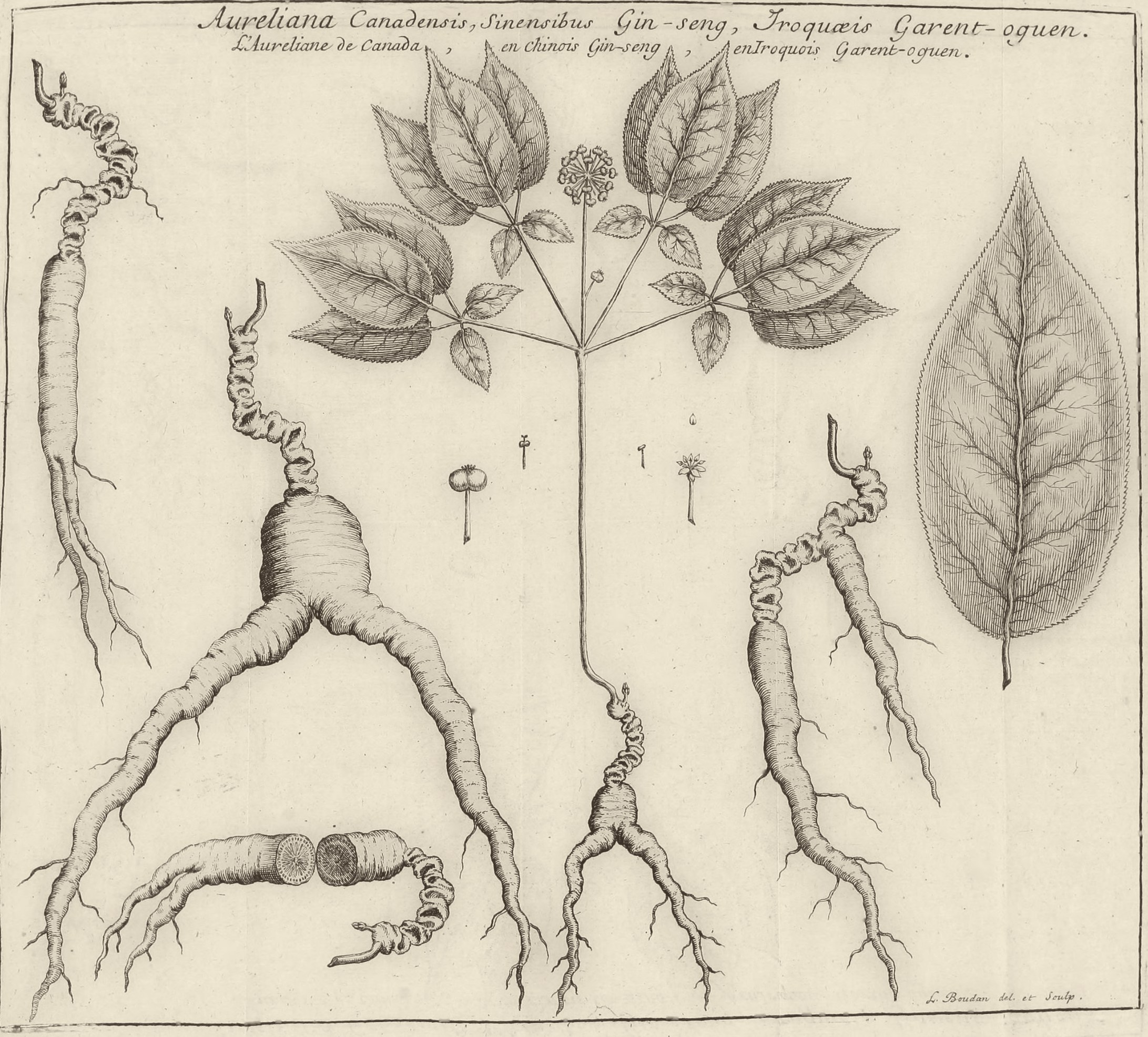
When Carl Linnaeus named the ginseng genus Panax, he picked a word that means "all-healing" in Greek, the same root as "panacea" [1]. No pressure, little root.
Ginseng has spent three centuries living up to that name in the market, if not always in the lab. It sat in Chinese medicine cabinets for centuries. It became a 1990s convenience-store staple when AriZona added ginseng tea to its range [2], a brand whose Big Can is still priced at 99¢ [3]. And it quietly helped launch trade between the young United States and China.
The North American chapter of that story starts not in a lab or a boardroom, but beside a house near Montreal.
1716: a Jesuit, a Mohawk healer and a botanical hunch
A French Jesuit in China, Pierre Jartoux, had written a detailed description of ginseng, with a drawing. He predicted that a plant needing such forests and climate might also grow in Canada [4]. In October 1715, a Jesuit missionary named Joseph-François Lafitau read that letter in Quebec and decided to go looking [4].
Lafitau worked at Sault-Saint-Louis, today's Kahnawake, near Montreal. He guessed that the Haudenosaunee, who held deep knowledge of medicinal plants, might know it [4]. He was right. A Mohawk woman he hired recognised the plant from Jartoux's drawing as a common remedy, and Lafitau found it growing by a house in 1716 [4]. In 1718 he presented his findings to the regent of France [4].
What followed was a rush. Collectors dug so hard to sell to China that they nearly wiped ginseng out of the St Lawrence valley [4]. It was an early lesson in what happens when a wild plant meets global demand.
1784: the root that paid for tea
If you read our tea article, you know that Britain paid for Chinese tea with silver, then with opium. The newly independent United States had another plan: ginseng.
On 22 February 1784, the Empress of China sailed from New York as the first American ship bound for China, carrying about 30 tons of ginseng along with furs and cloth [5]. It reached Canton on 30 August and came home in May 1785 with 800 chests of tea [5]. The voyage, backed by signers of the Declaration of Independence, earned a 25% return [5].
Roughly a decade after Boston threw tea into the harbour, Americans were buying it again, paid for with a root from their own forests. Ginseng was, in a sense, the young country's first big export brand to Asia.
There was also a warning in this boom. In the 1790s, naturalist William Bartram recorded Cherokee advice to gatherers: take no more than one root in four, and leave seed behind [6]. Sustainability is not a new idea; it is an old one that the market keeps forgetting.
From wild root to farm crop
Wild American ginseng could never meet demand, so farmers learned to grow it under shade. Today, two places dominate the cultivated crop: southern Ontario and Marathon County, Wisconsin.
The numbers show how the trade has shifted. In 2024, China imported nearly 3,000 tonnes of Canadian ginseng at about US$15 per kilogram, compared with 213 tonnes of US ginseng at about US$69 per kilogram, according to Chinese customs data reported by Reuters [7]. Canada is the volume supplier; Wisconsin sells a smaller, pricier crop.
Ginseng is also a demanding crop. A soil-borne disease means it cannot be replanted in the same ground, so growers must keep finding new land [8]. Each crop takes years in the ground before harvest.
2025: tariffs hit the "Napa Valley of ginseng"
Politics is now as important as soil. In Wisconsin, known as the "Napa Valley of American ginseng," the number of growers has fallen from about 1,400 a generation ago to fewer than 70 [7]. In 2025, US–China tariff fights slowed sales further, and growers held dried root while they waited for a deal [7]. "It's not profitable anymore," one Wisconsin grower told Reuters [7].
For Canadian growers, that is both a risk and an opening. China remains the key buyer, but trade tensions are a reminder to find more than one market.
The wellness rules: what NPN means
Ginseng today is sold as dried root, powders, teas, drinks and capsules, and that is where the value is added. In Canada, any product sold as a natural health product needs a product licence from Health Canada, which reviews it for safety and efficacy [9]. Approved products carry an eight-digit Natural Product Number, or NPN, on the label [9].
For anyone selling wellness products into Canada, or using a Canadian licence to reassure buyers abroad, that number matters.
What it means for buyers
- Know the grade and origin. Wild, woods-grown and field-cultivated ginseng sell at very different prices. Ask for origin and age documentation.
- Diversify markets. China and Hong Kong dominate demand, but tariff fights show the risk of selling to one market.
- Check the paperwork. For finished wellness products sold in Canada, look for the NPN on the label and the product licence behind it [9].
- Add value at home. Teas, extracts, capsules and functional drinks earn more than bulk dried root.
Not quite a panacea, but still a fortune
From a Mohawk healer's knowledge near Montreal to 30 tons of root that paid for America's first cargo of Chinese tea, ginseng shows how one plant can link forests, empires and trade wars. Linnaeus called it all-healing. The market has always called it valuable.
Nature Shire helps Canadian food, beverage and wellness brands reach buyers worldwide. Follow us on X at @NatureShire for more stories from the food system.
References
- Wikipedia, Panax.
- History Oasis, A visual history of AriZona Iced Tea.
- AriZona Beverages, About.
- Dictionary of Canadian Biography, Lafitau, Joseph-François.
- The China Project, The Empress of China and the beginning of U.S.-China trade (22 February 2023).
- NCpedia, Ginseng trade.
- Reuters, via Insurance Journal, China trade spat threatens Wisconsin's "Napa Valley" of ginseng (23 October 2025).
- Better Farming, Ontario ginseng growers have an edge in a $100-million market (1 November 2011).
- Health Canada, Natural health product licensing.
Banner image: “Aureliana Canadensis, Sinensibus Gin-seng, Iroquæis Garent-oguen”, drawn and engraved by Louis Boudan for Joseph-François Lafitau’s Mémoire on ginseng (Paris, 1718). Public domain, via Wikimedia Commons; cleaned and restored by Nature Shire.