Home/Insights/Silent Spring to Certified Organic:...
Canadian Products
Silent Spring to Certified Organic: The Book That Changed the Farm
NS
NatureShire Intelligence
Global Trade & Agrifood Editorial
Aug 22, 2026
·
8 min read
A British lord coined "organic farming" in 1940, Rachel Carson's Silent Spring turned pesticides into a public scandal, and Joni Mitchell sang about it. Today Canada's organic market is worth C$11.88 billion, and one 2009 agreement lets it sell organic across the US border.
In 1970, Joni Mitchell released "Big Yellow Taxi", the song about paving paradise to put up a parking lot. In one verse she asks a farmer to put away the DDT, the pesticide that was killing birds and bees [1]. It was a pop song with an unusually precise target, and the target came from a book.
Eight years earlier, a marine biologist named Rachel Carson had published Silent Spring. That book helped turn a small, slightly eccentric movement of British farmers and gardeners into the organic industry that now fills a whole section of Canadian supermarkets. The story crosses the Atlantic twice, from British estates to American bestseller lists to Canadian law.
1940: a lord names a movement
The phrase "organic farming" was coined by a British aristocrat, Walter James, Lord Northbourne, in his book Look to the Land, published in 1940 [2]. He described "the farm as organism": a living whole, not a factory [2].
The same year, botanist Sir Albert Howard published An Agricultural Testament. Howard had spent nearly 20 years advising farmers in India, from 1905 to 1924, and came to believe their traditional methods of returning waste to the soil were better than the chemical farming being taught in the West [2]. He is often called the father of modern organic agriculture [2].
In England, Lady Eve Balfour began a long experiment in 1939 comparing organic and chemical farming on her land in Suffolk. Her 1943 book The Living Soil led to the founding of the Soil Association, still Britain's main organic body [2]. In the United States, J. I. Rodale spread the ideas to home gardeners [2].
It was an empire's worth of ideas: knowledge gathered in colonial India, written up by British authors, and adopted by American gardeners.
1962: the book that changed the farm
The movement stayed small until 27 September 1962, when Rachel Carson published Silent Spring [3]. Carson did not call for an outright ban on DDT. She argued that overuse of DDT and similar pesticides was dangerous to people and wildlife and could disrupt whole ecosystems [3].
The chemical industry attacked her. Critics called her a fanatic and even "probably a communist" [3]. But the book became a bestseller. Carson testified before President Kennedy's Science Advisory Committee, the US Environmental Protection Agency was created in 1970, and the US began phasing out DDT in 1972 [3]. Silent Spring is often credited with launching the modern environmental movement [2].
The organic movement had its villain, its heroine and its moment. A Canadian songwriter gave it a chorus.
2009: Canada makes it official
For decades, "organic" meant whatever a farmer or a private group said it meant. Canada created a national system with the Organic Products Regulations, 2009, which set a single standard and a national Canada Organic logo [4].
The same year, on 17 June 2009, Canada and the United States agreed to treat each other's organic systems as equivalent [4][5]. Products certified organic in one country can be sold as organic in the other without a second certification, and can carry both the Canada Organic logo and the USDA Organic seal [5]. At the time, more than 80% of the organic food Canadians ate was imported, mostly from the US [5].
There are a few exceptions that matter for buyers. Canada does not accept hydroponically grown produce or products made with sodium nitrate as organic, and US organic animal products cannot come from animals treated with antibiotics [4]. To carry the logos, a product must be at least 95% organic [4].
A maple leaf the world trusts
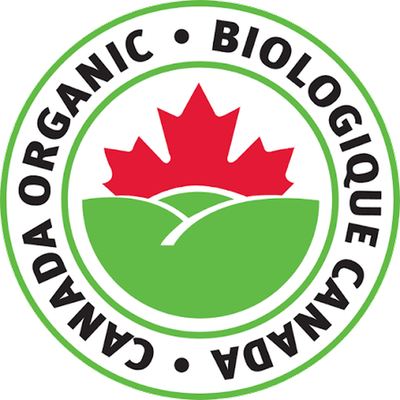
The Canada Organic logo may appear only on certified products that are at least 95% organic. Logo: Canadian Food Inspection Agency.
The Canada Organic logo is simple: a red maple leaf rising over green fields, with "Canada Organic" and "Biologique Canada" around the edge. Behind it sits a federal regulation. A product can carry the logo only if it is at least 95% organic and certified by a body accredited by the Canadian Food Inspection Agency, with farms and processors inspected along the way [4][7].
That is why the logo carries weight far beyond Canada. Canada has organic equivalency arrangements with nine partners: the United States, the European Union, the United Kingdom, Switzerland, Japan, South Korea, Taiwan, Mexico and Costa Rica [7]. In practice, a product certified organic in Canada can be sold as organic in some of the world's largest and most demanding food markets, without starting the certification process again.
For buyers, the logo is a shortcut to trust: someone has checked the farm, the ingredients and the paperwork. For Canadian food and beverage brands and producers, it is a badge worth wearing with pride. It tells shoppers in Toronto, Tokyo or Frankfurt that the product meets a standard recognized well beyond Canada's borders.
2026: a C$11.88 billion market
Canada's organic market was worth C$11.88 billion in 2025, up 24% from 2023, according to the Canada Organic Trade Association [6]. Back in 2009, the US government estimated the Canadian organic market at C$2.1–2.6 billion [5]. In about 15 years, it has grown roughly four- to five-fold.
That growth is an opening for Canadian farmers and processors who still import much of what Canadians buy organic. It is also an export opportunity: Canadian organic grains, pulses, maple syrup and honey can cross into the US under the equivalence arrangement, and into other markets with their own agreements.
What it means for buyers
Check the certificate, not just the logo. For trade between Canada and the US, each shipment needs an organic certificate from an accredited body, with the equivalence attestation [4].
Know the exceptions. Hydroponic produce cannot be sold as organic in Canada, and antibiotic-treated animal products cannot be sold as organic in the US [4].
95% is the line. Only products with at least 95% organic content can carry the Canada Organic logo or USDA Organic seal [4].
Demand is growing at home. A C$11.88 billion market that still relies on imports leaves room for Canadian suppliers [5][6].
From a silent spring to a crowded aisle
A lord's book, a botanist's notes from India, a biologist's warning and a Canadian folk song all fed into what is now a mainstream supermarket category. Rachel Carson wanted people to ask what was being sprayed on their food. Sixty years later, the organic logo is the answer millions of shoppers look for.
Nature Shire helps Canadian food and beverage brands, organic producers included, reach buyers worldwide. Follow us on X at @NatureShire for more stories from the food system.
References
Far Out Magazine, "Was Joni Mitchell's 'Big Yellow Taxi' the first environmentalist song?" https://faroutmagazine.co.uk/was-joni-mitchell-big-yellow-taxi-the-first-environmentalist-song/
Wikipedia, "History of organic farming." https://en.wikipedia.org/wiki/History_of_organic_farming
History.com, "Rachel Carson's Silent Spring is published" (27 September 1962). https://www.history.com/this-day-in-history/september-27/rachel-carson-silent-spring-published
Canadian Food Inspection Agency, "Canada–United States Organic Equivalency Arrangement: overview." https://inspection.canada.ca/organic-products/equivalence-arrangements/uscoea-overview/eng/1328068925158/1328069012553
Two drums of Prairie buckwheat honey go by sea to the UK. Fresh Okanagan cherries fly to South Korea. We follow both orders step by step: the paperwork, certifications, border rules and how long each journey really takes.
Plant-based burgers went from Wall Street's hottest IPO to a sales slump in six years, yet the world's appetite for protein keeps growing. Here's why the fake-meat hype faded, where plant protein is heading next, and why Canada, the world's largest pea producer, is well placed.
Bertie Wooster fed Jeeves fish for brain power, Danish doctors built an industry on the Greenland Inuit diet, and a Canadian scientist later said the evidence was thin. Inside the omega-3 business, from cod liver oil to Nova Scotia refineries and Prairie flax.