
Ted Lasso had a point. Arriving in England, the fictional American football coach tries his first cup of tea and announces that he always thought it would taste like "hot brown water," and he was right [7]. It is a good joke, and it is also a little ungrateful, because the United States exists in its current form partly because of that hot brown water. So, in a roundabout way, does Hong Kong's skyline, Darjeeling's hillsides and Kenya's place as one of the world's great tea exporters.
Few products have rewired the world like Camellia sinensis. Follow one leaf for 360 years and you pass through a royal wedding, a midnight raid, two wars, a botanical heist and, today, a climate crisis that is quietly redrawing the tea map.
1662: a queen, a chest of tea and a city thrown in
When the Portuguese princess Catherine of Braganza married Charles II in May 1662, her dowry included a chest of tea and the port of Bombay, today's Mumbai [1]. Charles later rented Bombay to the East India Company for £10 a year in gold [1]. Remember that company; it is the villain, hero and accountant of this story.
Catherine did not introduce tea to Britain. Samuel Pepys had already tried "a China drink" in 1660 [1]. But she made it fashionable at court, and fashion did the rest. Within a century, Britain was hooked, and almost all of its tea came from one supplier: China.
1773: the most expensive party in history
By the 1770s the East India Company was in trouble, sitting on about 17 million pounds of unsold tea in English warehouses [2]. Parliament's fix was the Tea Act of 1773, which let the company sell tea in the American colonies more cheaply than smugglers could, while keeping a tax the colonists already resented [2][4].
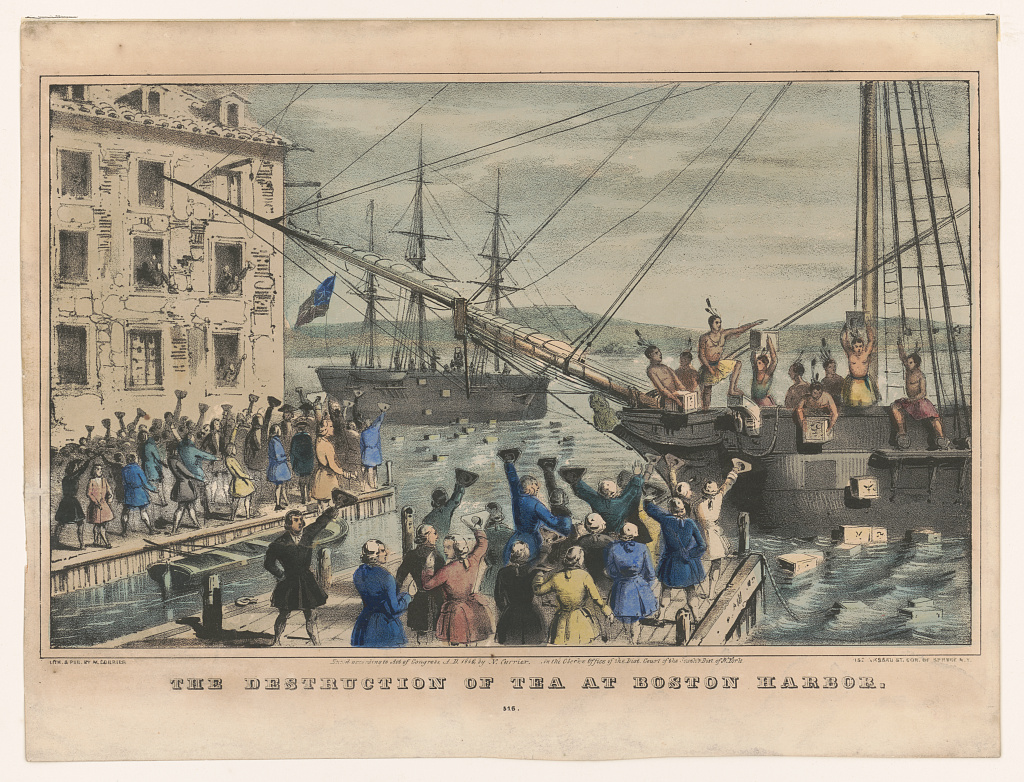
Cheap tea with a side of "taxation without representation" went down badly. On 16 December 1773, colonists disguised as Mohawk warriors boarded three ships in Boston Harbor, the Beaver, the Dartmouth and the Eleanor, and dumped 342 chests of East India Company tea into the water [3][4]. That was more than 92,000 pounds of tea [4]. New York staged its own tea party in April 1774 [2]. Within three years, the colonies had declared independence.
A corporate bailout meant to help a London company sell surplus stock helped start a revolution. Marketing departments, take note.
1839: the silver problem and the Opium Wars
On the other side of the world, the same thirst was creating a different crisis. Britain wanted Chinese tea, silk and porcelain, but China wanted little that Britain made, so Britain paid in silver, and lots of it [5].
The East India Company's answer was opium. It expanded poppy cultivation in Bengal and sold the drug to private traders, who smuggled it into China. By 1797 it was selling about 4,000 chests a year [5]. The silver began to flow the other way, and addiction spread.
In 1839 the Chinese official Lin Zexu seized more than 20,000 chests of opium, about 1,300 tonnes, and destroyed them at Humen [5]. Britain went to war. The First Opium War (1839–1842) ended with the Treaty of Nanking, which opened Chinese ports such as Shanghai to Western merchants and handed Hong Kong to Britain until 1997 [5]. A second war (1856–1860) forced China to legalise the opium trade [5].
The same leaf that sank in Boston Harbor had now helped redraw China's coastline.
1848: the great tea heist
Britain's next move was to stop depending on China at all. In 1848 the East India Company hired Scottish botanist Robert Fortune, at five times his salary, to do something China prohibited: take its tea plants and its know-how [6].
Fortune shaved his head, wore Chinese dress and travelled deep into the tea districts. He smuggled out about 20,000 seedlings in Wardian cases, sealed glass boxes that worked like portable greenhouses, along with experienced Chinese tea workers [6]. The plants went to Darjeeling, and the processing knowledge helped Darjeeling and Assam become major exporters [6]. Writer Sarah Rose tells the full story in For All the Tea in China [6].
It was industrial espionage on a continental scale. India, then Sri Lanka and East Africa, went on to become tea giants, and China's near-monopoly was over.
Meanwhile in Canada and the United States
North America never quite gave up tea; it just reinvented it. In 1890, Theodore Harding Estabrooks founded Red Rose Tea in Saint John, New Brunswick, and its old advertising line, "Only in Canada, you say? Pity," became a piece of Canadian pop culture [8].
Americans, meanwhile, put it on ice. They drank almost 86 billion servings of tea in 2023, and about 75–80% of it was iced [10]. The US is now the world's third-largest tea importer, after Russia and Pakistan [10]. Then there is bubble tea, created in Tainan, Taiwan, in the mid-1980s, which spread through North American cities from the 2000s and now sits on mainstream menus [9].
2026: the heat is on the teapot
The newest chapter is being written by the weather. Tea needs steady rain and moderate temperatures, and it is getting neither.
- India: national output fell about 9% in June 2025 from a year earlier. In Assam, June production fell about 12% after rainfall came in roughly half of normal and daytime temperatures topped 36°C [11].
- Kenya: production fell 11.5% in the first seven months of 2025, which the Tea Board of Kenya put down to long dry and cold spells [12]. Pakistan, Kenya's biggest buyer, takes about a third of its exports [12].
- The long view: an FAO official said in 2025 that land suitable for tea could shrink by up to 55% by 2050, especially in East Africa, with yields in Northeast India projected to fall by as much as 40% [13]. An earlier FAO study in Kenya found suitability falls where average temperatures rise above 23.5°C [14].
The East India Company spent two centuries trying to control where tea came from. Climate change may now decide it for everyone.
What it means for buyers
For retailers, distributors and importers, tea's history is a lesson in concentration risk, and that lesson still applies.
- Spread your origins. Buying from one country, or one region, leaves you exposed to a single bad monsoon or dry season.
- Expect price swings. Weather-driven shortfalls in Assam and Kenya push auction prices up, and those costs reach your shelf.
- Sell the story. Provenance, estate names and fair labour practices matter to North American shoppers, especially in specialty and ready-to-drink tea.
- Watch the new formats. Iced tea, ready-to-drink tea and bubble tea are where North American growth is, not only the hot cup.
Your cup, your call
The next time you dunk a teabag, you are holding a drink that crowned a queen's fashion, emptied a harbour, started two wars and inspired a heist. Ted Lasso may still think it is hot brown water. He is not wrong, but he is missing the plot.
Nature Shire helps Canadian food and beverage brands reach buyers worldwide. Follow us on X at @NatureShire for more stories from the food system.
References
- UK Tea & Infusions Association, Catherine of Braganza.
- Encyclopædia Britannica, Tea Act.
- Encyclopædia Britannica, Boston Tea Party.
- Boston Tea Party Ships & Museum, The Tea Act.
- Wikipedia, Opium Wars, citing Wallbank et al., Civilizations Past and Present (1992).
- The National (Scotland), The Scottish botanist who brought tea from China to India (2024); Sarah Rose, For All the Tea in China (2010).
- CinemaBlend, 32 of Ted Lasso's funniest lines.
- Wikipedia, Red Rose Tea.
- Encyclopædia Britannica, Bubble tea.
- Tea Association of the USA, Tea Fact Sheet 2024.
- Outlook Business, India's tea production drops in June as extreme weather hits plantations (4 August 2025), using Tea Board of India data.
- Food Business MEA, Kenya's tea output falls 11.5% in first seven months of 2025 (6 October 2025), using Tea Board of Kenya data.
- Daily Sabah, Tea farms could shrink by 2050 due to climate crisis: FAO (23 May 2025).
- FAO, Climate Change and Tea in Kenya: Impact Assessment and Policy Response (project brief).
Banner image: Nathaniel Currier, “The Destruction of Tea at Boston Harbor,” 1846. Library of Congress, public domain.