When the Roman writer Pliny the Elder first described sugar in the 1st century, the best he could do was call it "a kind of honey found in cane". For most of history, honey was sweetness. Then crusaders carried cane sugar home, Venetian traders built a business on it, and Caribbean plantations worked by enslaved people made it cheap. By 1770 Britain ate five times as much sugar as it had in 1710, and honey slid from staple to specialty.
Honey's arrival in Canada is a trade story too. Honeybees are not native to the Americas. The first recorded hives crossed the Atlantic to Virginia in 1622, and their swarms ran so far ahead of the settlers that, as Thomas Jefferson recorded, Indigenous peoples called them the "white man's fly".
Four centuries later, Canadian honey faces the same question cane sugar settled for honey long ago: is it a commodity, priced by the barrel, or a craft, priced by its story? Statistics Canada's figures for 2021 to 2025 give a clear answer. The money is in provenance, not volume.
1. Canada buys more honey abroad than it sells abroad
Canada produced 84.1 million pounds of honey in 2025, worth C$241 million at the farm gate, from 16,317 beekeepers. Yet by value, honey imports beat honey exports in every year from 2021 to 2025. The gap grew sevenfold, from a C$2.8 million deficit in 2021 to C$19.6 million in 2025 (about C$54M exported against C$73M imported).
The flow runs both ways. In 2025 Canada shipped out roughly 1 in 4 pounds of the honey it produced, while imports made up more than a quarter of the honey available to Canadians.
Not every imported jar is what its label says. In targeted testing reported in 2023, the Canadian Food Inspection Agency found 17 of 74 imported samples (22.9%) were not authentic honey. The sampling focused on high-risk shipments, so the rate is not typical of all imports, but it shows why traceable origin matters to buyers.
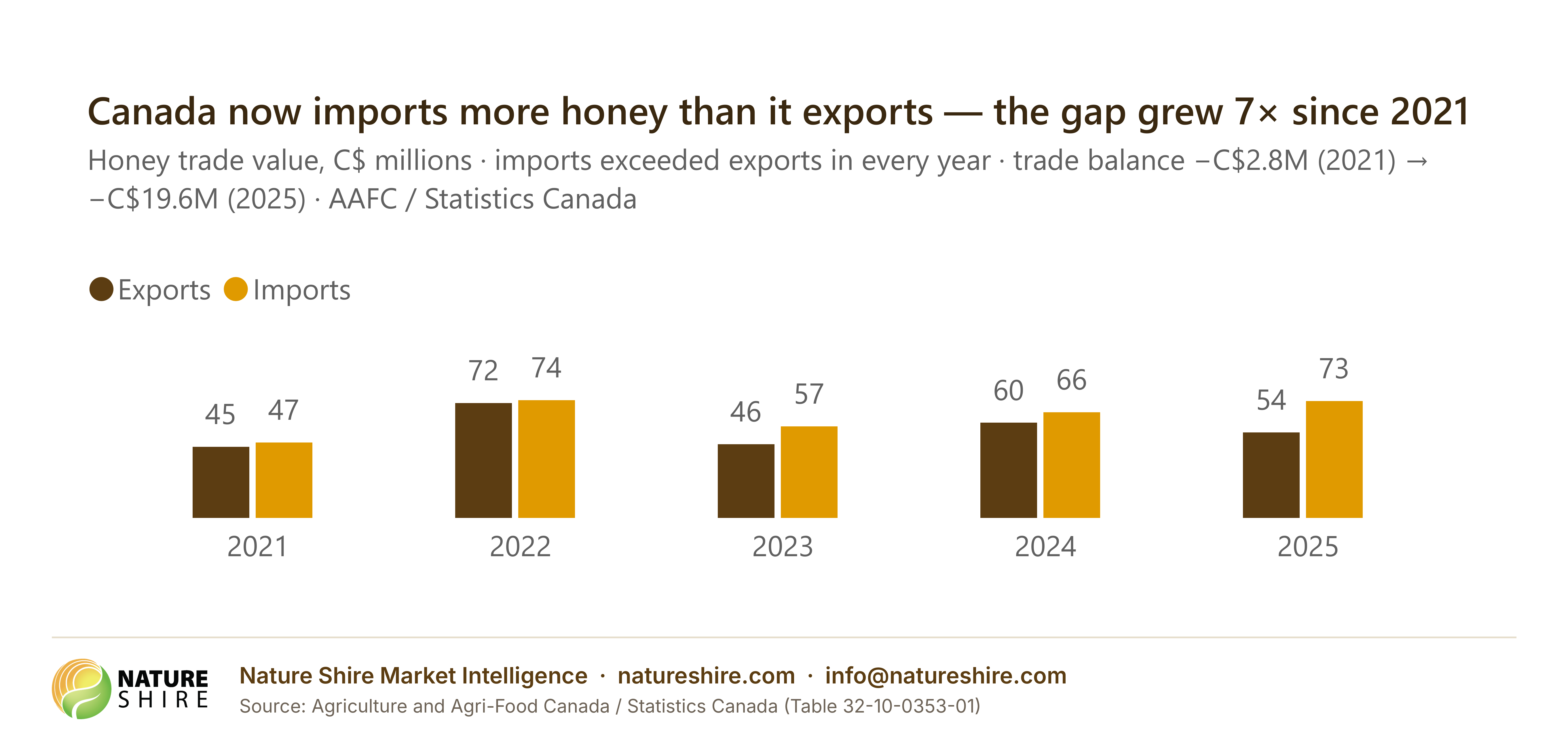
What it means: the demand is already here, and part of it is being met from abroad. That is shelf space a Canadian brand with a provable origin can win, at home and in export markets.
2. The price is in the provenance
A kilo of New Zealand honey landed in Canada at C$41.29 in 2025. A kilo of Canadian honey left the country at an average of C$5.63. That is a 7× gap for the same sticky product. New Zealand supplied only 3% of Canada's honey imports by volume but 22% by value. Australian honey (C$13.42/kg) and Saudi honey (C$11.30/kg) also landed well above Canada's export price.
The difference has a name: mānuka. New Zealand turned the nectar of one native shrub into a certified brand, with laboratory tests for its signature compounds and an industry body, the UMF Honey Association, formed in 2002 to grade it. The result: New Zealand makes about 1% of the world's honey by volume but earns nearly 9% of global honey trade value. Success invites imitation. Industry research once estimated that six times more "mānuka" was sold worldwide than New Zealand actually produced, which is exactly why the certification exists.
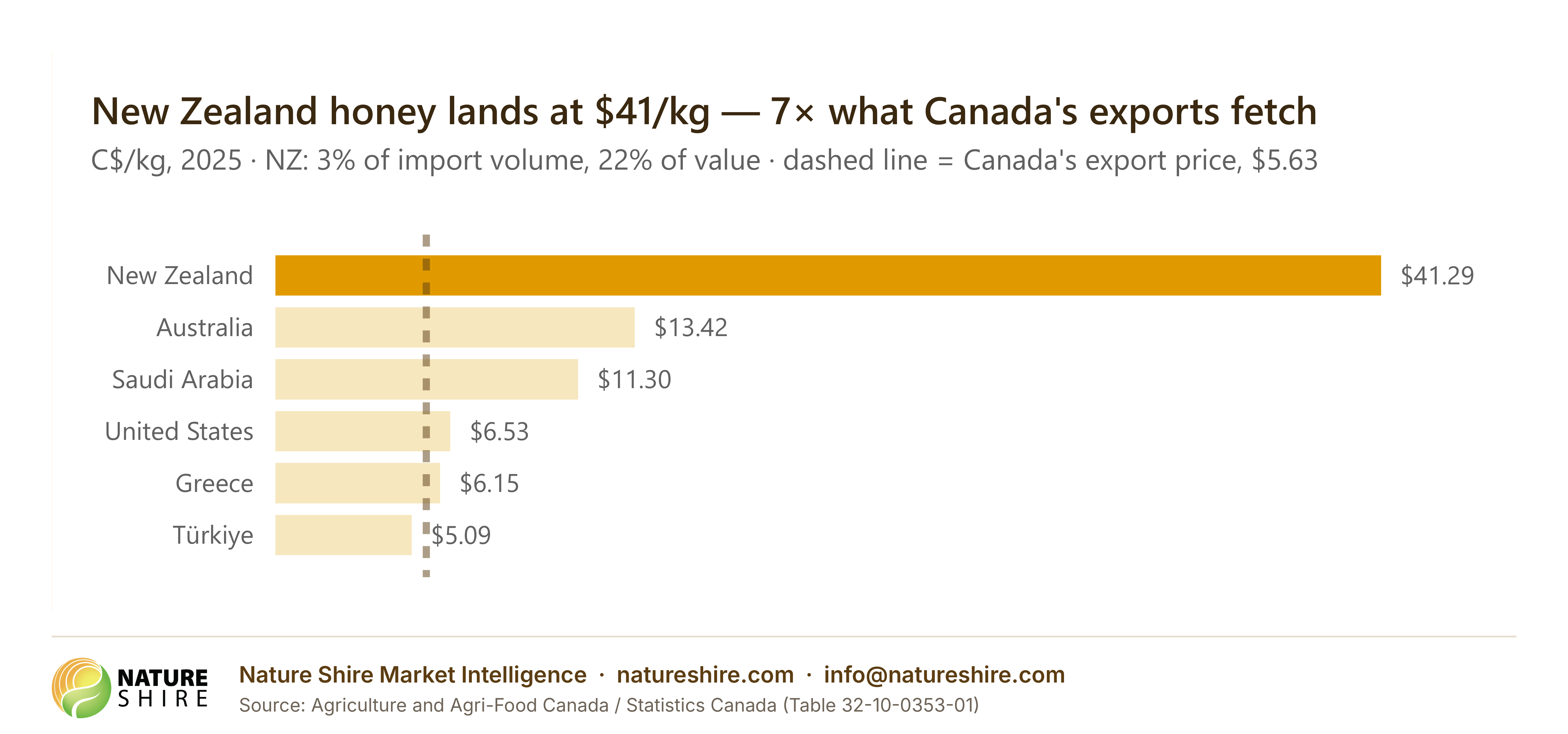
What it means: buyers do not pay 7× for sweetness. They pay for an origin they can verify, a story they can repeat, and proof on the label. Canadian honey has the first two. It rarely sells the third.
3. More beekeepers, not more honey
Canada has 22% more beekeepers than in 2021, led by Ontario (+61%) and British Columbia (+25%). Over the same years the number of colonies barely moved (+2%), and honey output fell 5%, after a sharp 16% dip in 2022.
More people are sharing roughly the same number of hives. The arithmetic points to smaller operations on average: the kind that sell at farmers' markets and to a local following, with a story already attached. What most of them lack is scale, export paperwork and a route to buyers beyond their own region.
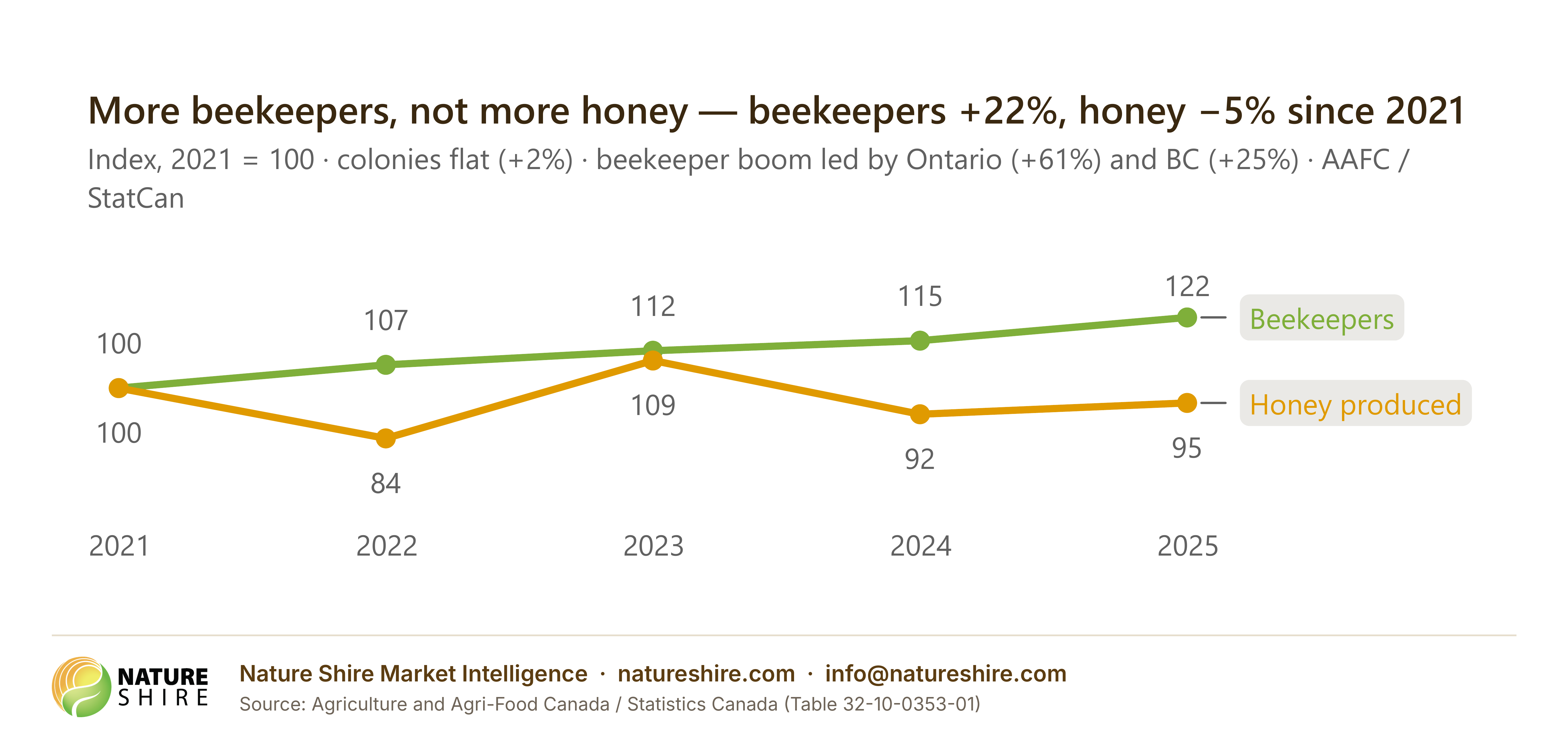
What it means: Canada's beekeeping growth is in craft, not commodity. The missing piece is not more bees. It is access to markets that pay for what small producers already make.
4. The Prairies make the honey. BC earns the premium.
Alberta, Manitoba and Saskatchewan produce 80% of Canada's honey by volume, much of it from vast fields of canola and clover. Alberta alone made 34.2 million pounds in 2025, worth C$77.0 million. British Columbia made just 4.0 million pounds, worth C$23.8 million.
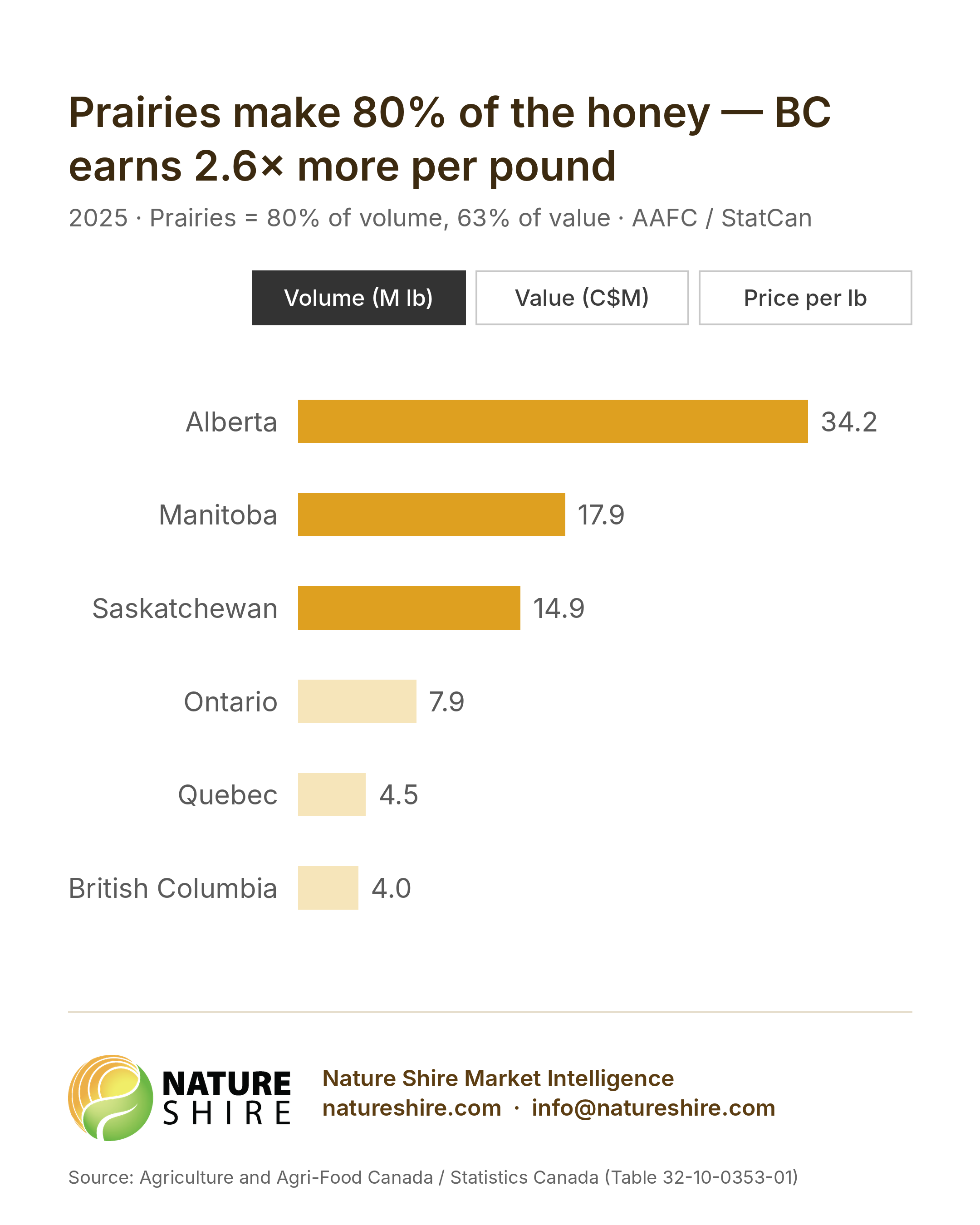
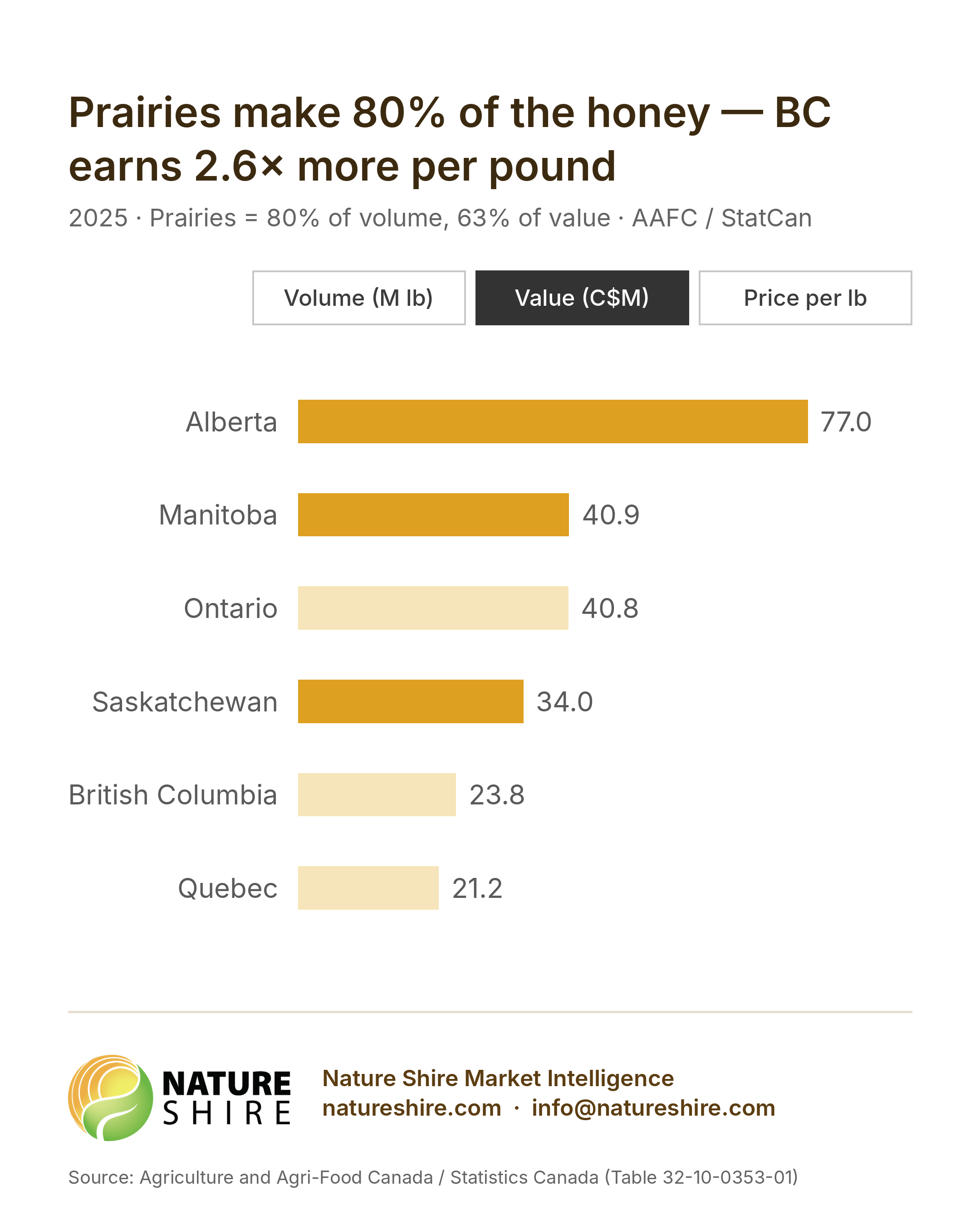
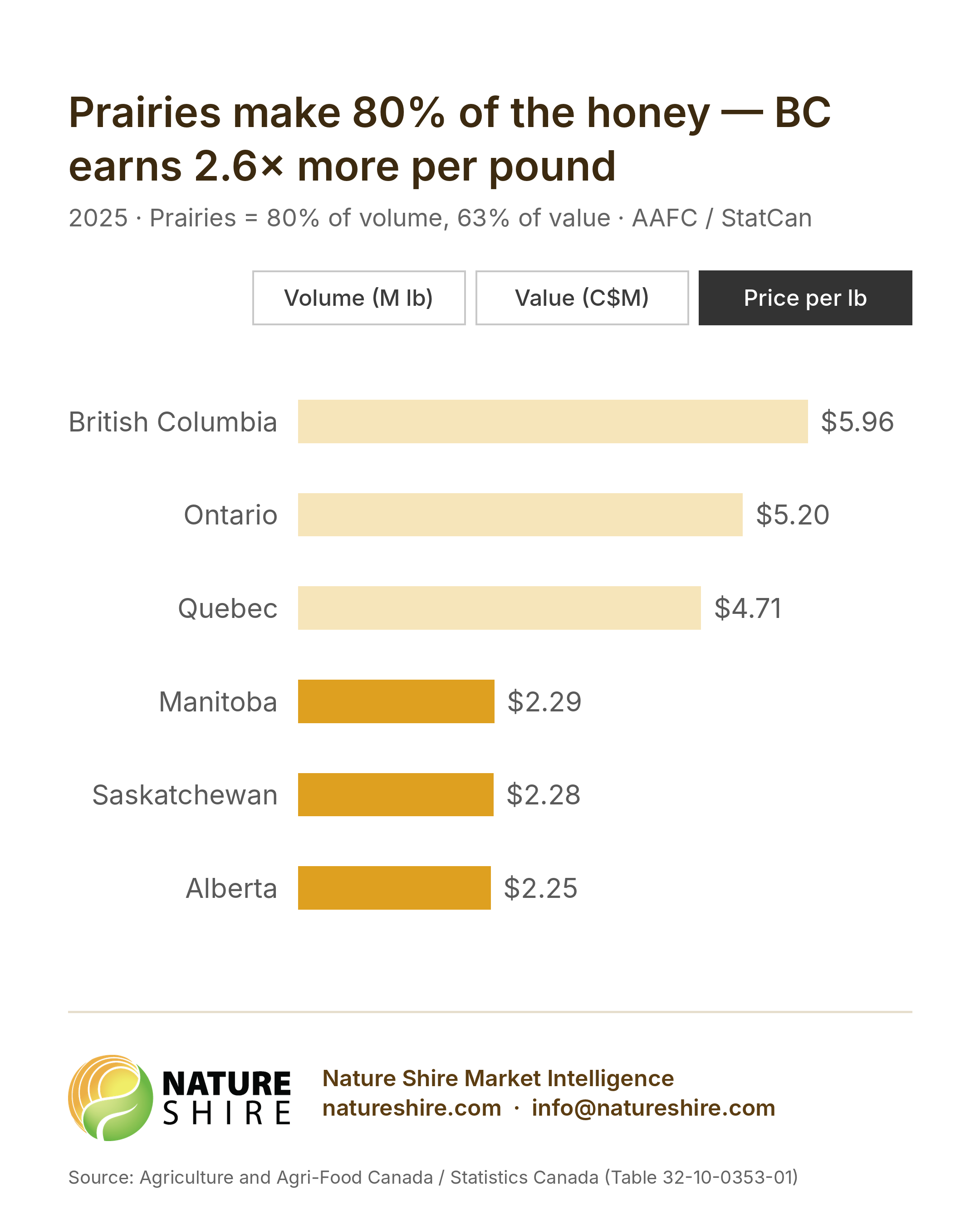
Per pound, the order flips. BC honey earned C$5.96/lb at the farm gate, against C$2.25 in Alberta: 2.6× more. Ontario (C$5.20) and Quebec (C$4.71) also sit far above the Prairie provinces, which cluster at C$2.25 to C$2.29. So the Prairies make 80% of the honey but earn 63% of its value.
The Prairie model is bulk: large operations, big monofloral harvests, sold by the drum. The BC and Ontario model is closer to craft: smaller lots, sold nearer to the buyer, often under the beekeeper's own name.
What it means: Canada's own market already pays 2.6× more for honey with a story and a short route to the shopper. The opportunity is to carry that premium abroad, and to give Prairie producers a way to capture some of it.
Commodity or craft? What it means for Canadian food brands
The data answer the title question: Canada still sells most of its honey as a commodity, while the money flows to craft. Three lessons travel well beyond honey, to maple syrup, berries, grains and seafood.
- Sell the origin, not the commodity. New Zealand earns 7× Canada's export price because it sells a place, a plant and a certificate. Canadian honey has origins worth naming: BC wildflower, Prairie canola, Quebec buckwheat.
- Win back the home shelf. Canada imports more honey than it exports by value, and the gap is growing. Import substitution starts with a label shoppers believe at a glance.
- Give small producers a route to market. Beekeeper numbers are up 22%. What they lack is buyers, not bees.
For buyers abroad (retailers, distributors and wholesalers), Canadian honey offers what premium shelves pay for: a clear origin, a government-defined product standard, and a supply base that is growing in number if not in drums.
Nature Shire is an export and sales platform for Canadian food and beverage brands. We turn data like this into market choices: which product, which market, and at what price. If you make honey, maple or other Canadian food products and want to reach new markets, visit natureshire.com or write to info@natureshire.com.
Sources
- Data: Agriculture and Agri-Food Canada / Statistics Canada, Production and value of honey (Table 32-10-0353-01) and honey trade data, 2021–2025. Charts and analysis: Nature Shire Market Intelligence.
- Canadian Honey Council, statement on the CFIA honey fraud report (2023).
- Mānuka honey, Wikipedia (citing FAOSTAT and UMF Honey Association research).
- Jennie Durant, How bees came to the United States and changed our landscape, Literary Hub.
- History of sugar, Wikipedia (Pliny the Elder, Natural History).