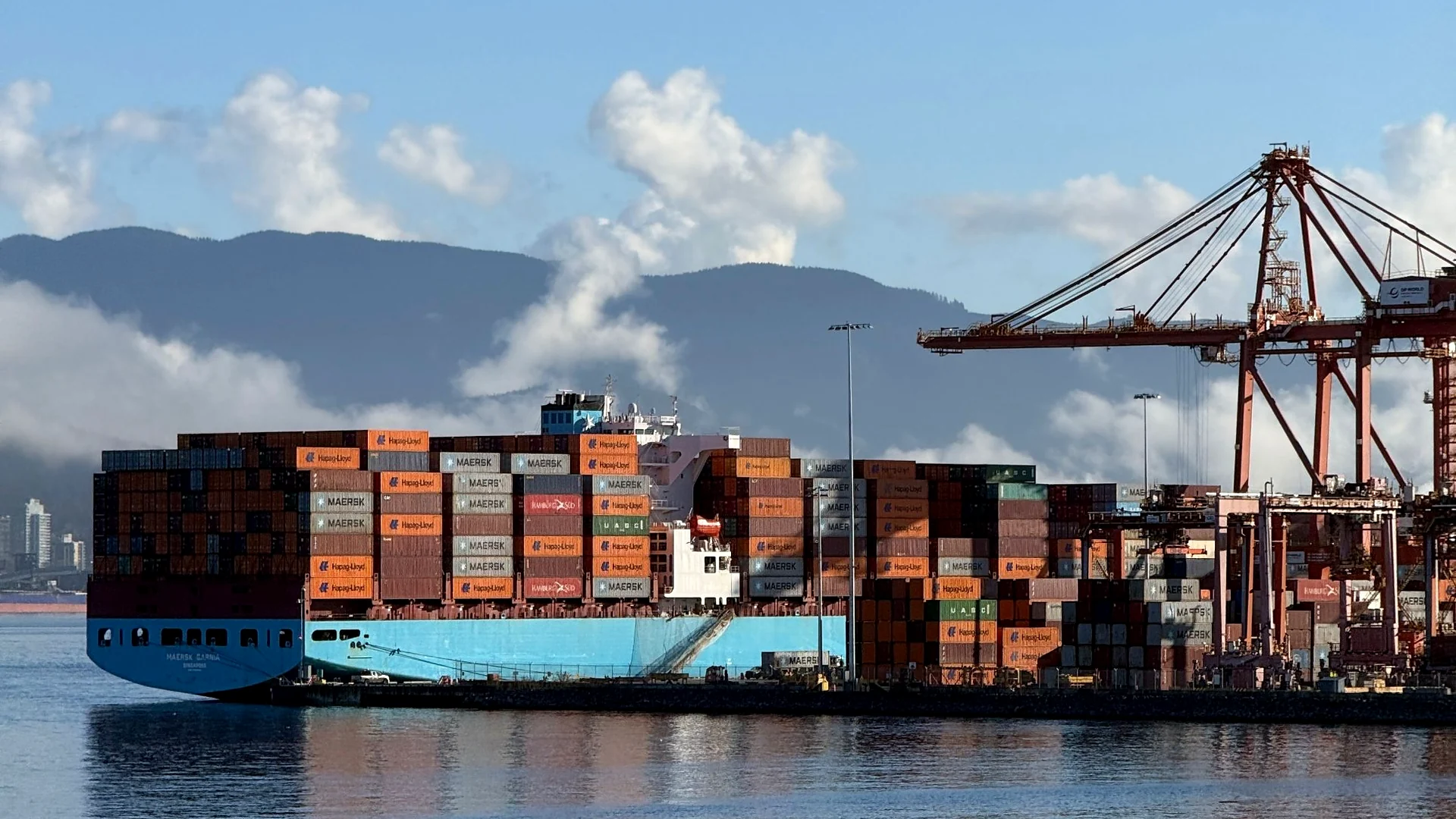
On 21 February 1911, a British MP rose in the House of Commons with an unusual worry: what would British millers do if "Manitoba hard grain" were diverted to American mills? Britain's flour mills had come to depend on Canadian prairie wheat, and the thought of losing it was enough to put the question on the parliamentary record.
Red Fife had made that wheat famous for its milling and baking. Its successor, Marquis, developed by Charles Saunders and first handed out to farmers in 1909, ripened about a week earlier, dodged the prairie frosts, and milled into a "strong" flour that bakers around the world wanted. By 1920, 90% of the wheat grown in western Canada was Marquis. More than a century later, British supermarkets still sell flour labelled as Canadian strong white.
So you might expect Canada to be one of Britain's big food suppliers. It isn't. Four charts built from Agriculture and Agri-Food Canada (AAFC) and Statistics Canada data show where Canada stands in the UK, and where the opening is for Canadian food and beverage brands.
1. Canada sells the UK less than one cent of every food dollar
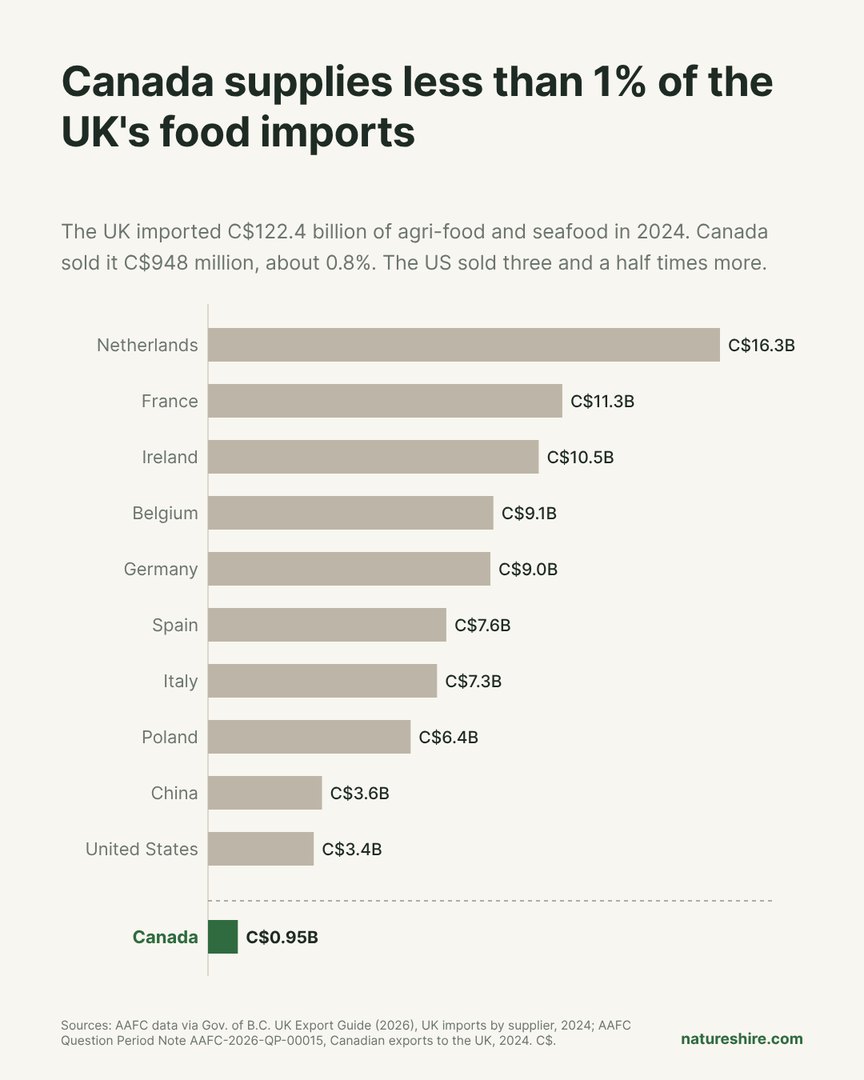
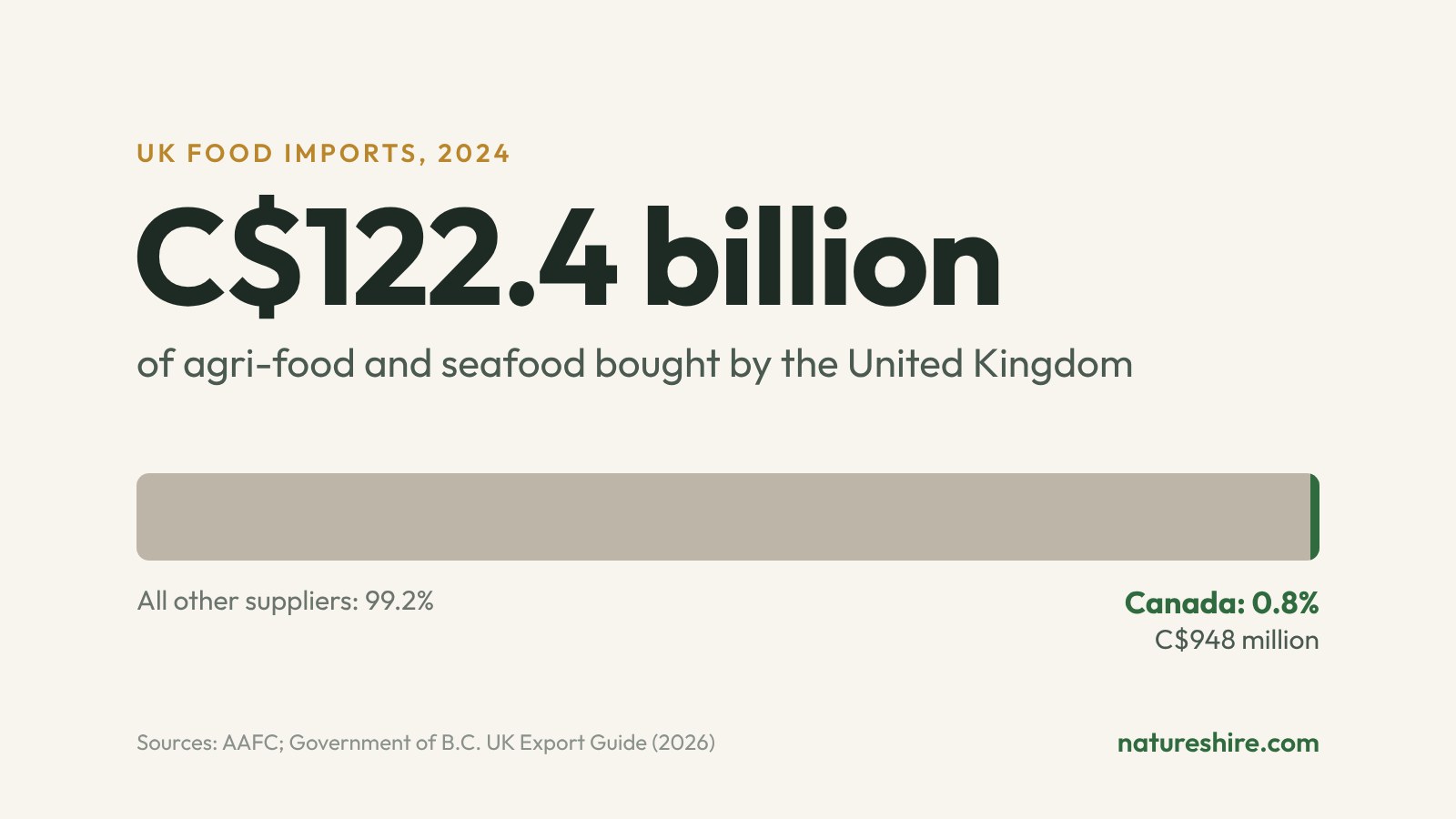
The UK imported C$122.4 billion of agri-food and seafood in 2024, making it the world's fifth-largest buyer. Most of it comes from next door. The Netherlands alone sold Britain C$16.3 billion, France C$11.3 billion and Ireland C$10.5 billion.
Canada sold C$948 million. That makes the UK Canada's ninth-largest agri-food and seafood market, but Canada's share of what Britain buys is about 0.8%. The United States, with the same Atlantic to cross, sells three and a half times as much.
2. Momentum: Canadian sales to the UK grew 14.5% in 2025
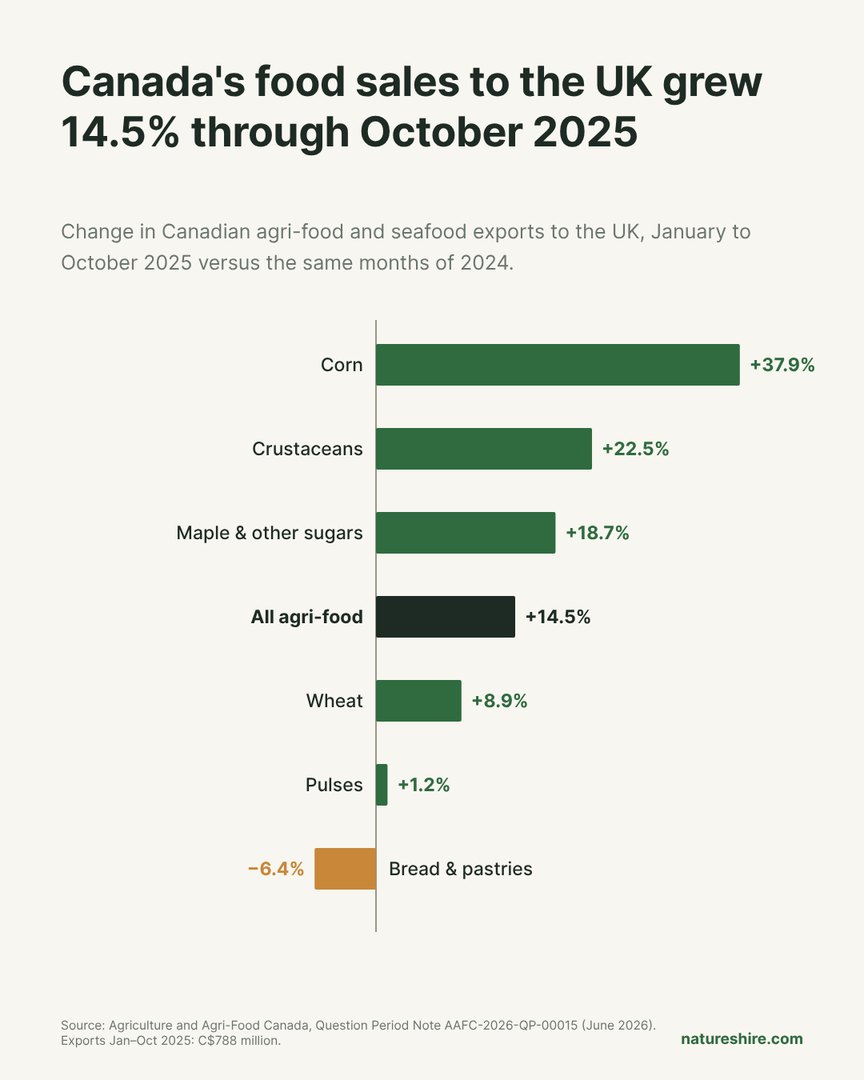
The trend is moving the right way. From January to October 2025, Canada's agri-food and seafood exports to the UK reached C$788 million, up 14.5% on the same months of 2024. Corn rose 37.9%, crustaceans 22.5%, and maple and other sugars 18.7%. Wheat, the old staple, added another 8.9%.
Not every line grew. Bread and pastries fell 6.4%. And beef shows how quickly a trade can disappear: Canadian beef exports to the UK fell from 1,415 tonnes (C$17.7 million) in 2020 to 517 kilograms (C$25,000) in 2024, while Canada imported 5,182 tonnes of British beef that same year. Market access is never automatic.
One fast-growing line sits outside the food figures above: medical cannabis. The UK allows it only on a specialist’s prescription, and its imports reached 30 tonnes in 2025. Canadian producers shipped 17 tonnes of that, 57% of the total and more than six times their 2024 volume, according to UK Home Office data obtained by Prohibition Partners. For licensed Canadian producers with EU-GMP certification, it is one of the clearest openings in the British market.
3. Britain's biggest food import is bread, and Canada supplies 1.4% of it
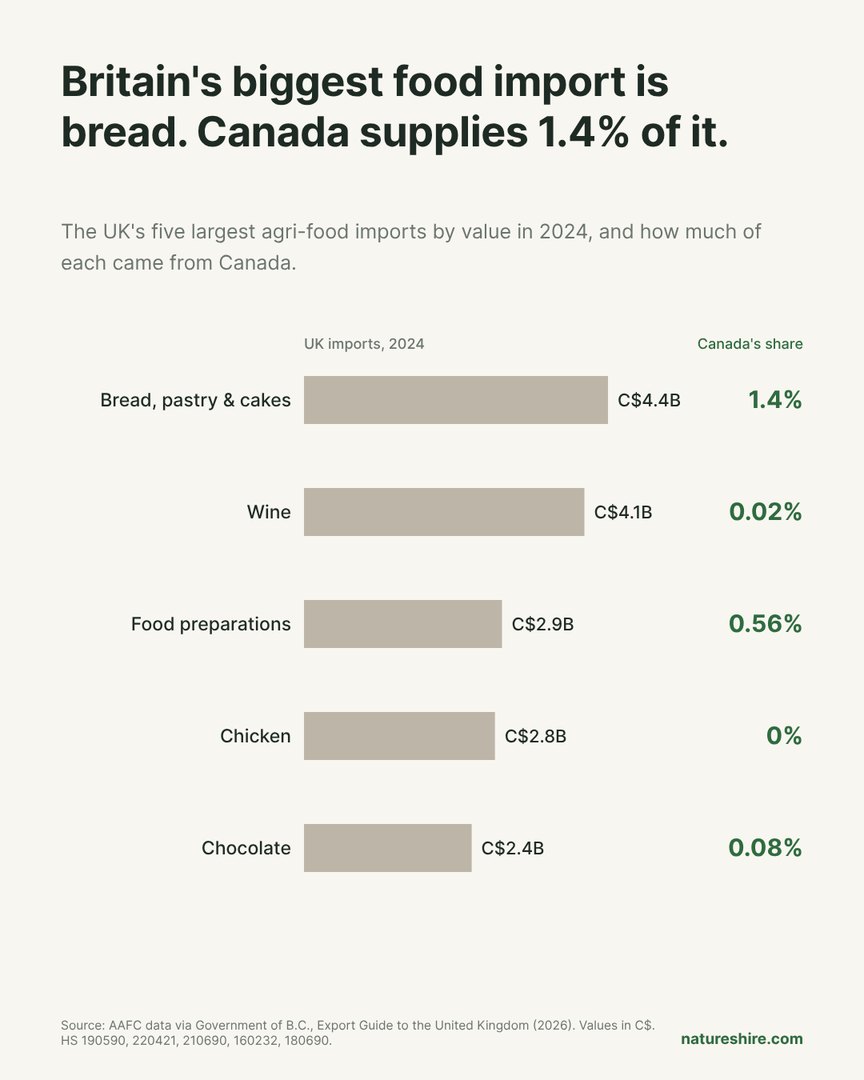
Here is the twist. The single largest item on Britain's food import bill is bread, pastry and cakes, at C$4.4 billion in 2024. The country whose wheat built the British loaf supplies 1.4% of it. Canada's share of the UK's other big-ticket imports is smaller still: 0.56% of food preparations, 0.08% of chocolate, and almost nothing of wine or chicken.
That gap is the opportunity. Canada mostly ships the ingredients, while France, Ireland and Germany ship the finished, branded products that sit on British shelves. British shoppers are also spending on the categories where Canadian brands are strong: UK organic sales reached about US$4.9 billion in 2024, up 7.3%. And shelf space is concentrated, with Tesco, Sainsbury's, Asda and Aldi holding about two-thirds of the grocery market, so one good listing goes a long way.
4. B.C.'s food sales to Britain are picking up fast
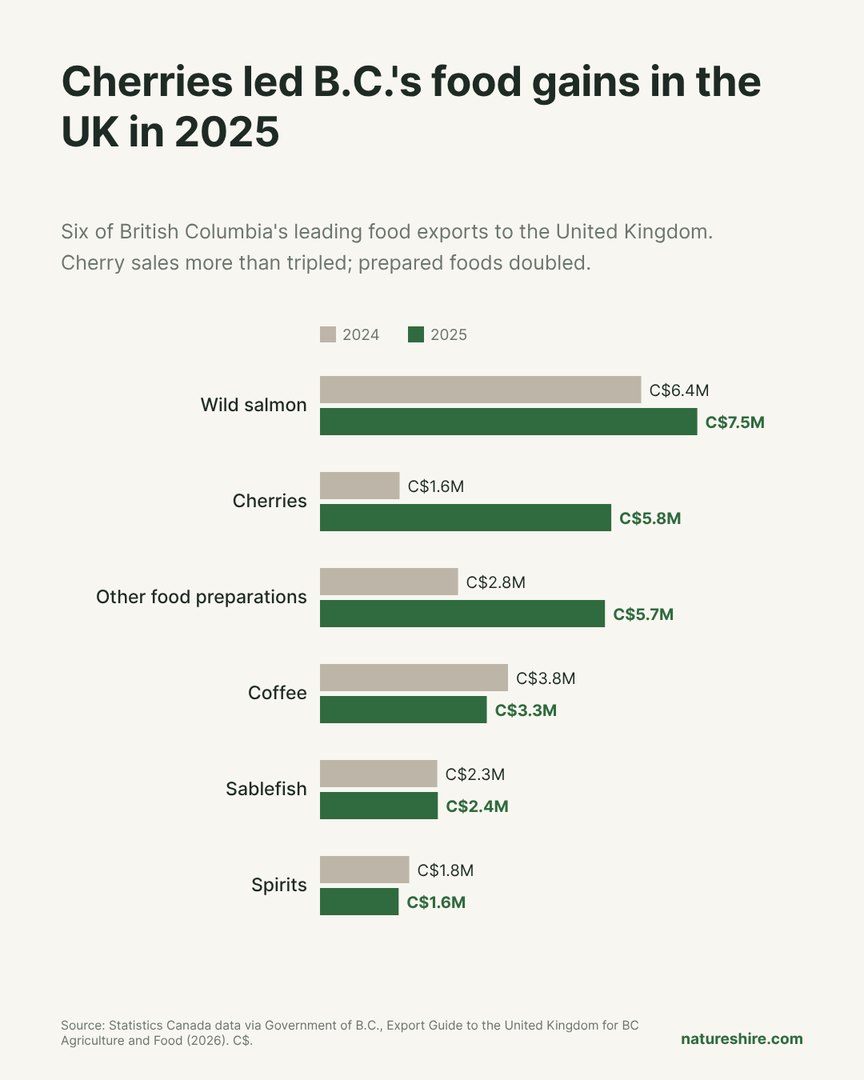
British Columbia's leading food exports to the UK tell a promising story. Cherry sales more than tripled in 2025, from C$1.6 million to C$5.8 million. Other food preparations doubled to C$5.7 million, and wild salmon, B.C.'s biggest food line in the UK, rose to C$7.5 million.
One line deserves a smile: B.C. sold Britain C$3.3 million of coffee in 2025. A province on the Pacific is selling coffee to the nation that turned tea into an empire.
The rules of the road
- Tariffs: the Canada–UK Trade Continuity Agreement has been in force since 1 April 2021, and about 99% of trade between the two countries is duty-free. Poultry and eggs are excluded.
- A fuller deal is on hold: the UK paused free trade talks in January 2024, citing cheese access. Both countries are also in the CPTPP, which took effect for the UK in December 2024; as of AAFC's June 2026 briefing, Canada had not yet ratified the UK's accession.
- Costs at the border: duty-free goods still pay 20% VAT, and alcohol pays excise duty. Since January 2025, the UK's Extended Producer Responsibility rules also charge for packaging.
- Time on the water: ocean freight from Canada takes about 20 to 40 days, which shapes shelf-life and pricing.
What this means for Canadian brands
Britain already knows Canada through its flour, its salmon and its maple syrup. What it rarely sees is a Canadian brand on the shelf. The market is big, the tariffs are mostly gone, and demand for natural, organic and specialty foods is growing. What most Canadian producers lack is a UK importer, labels that meet UK rules, and pricing that still works after freight, duties and retailer margins.
How Nature Shire helps
Nature Shire began in the United Kingdom, working with British food and beverage brands, before moving its focus to Canadian producers. We connect small and mid-sized Canadian food and beverage brands with buyers abroad and handle what sits in between: finding importers, paperwork, payment and freight.
If you make a Canadian food or beverage product and want to know whether Britain is right for it, get in touch with us.
About the data
All values are in Canadian dollars. UK import totals and supplier figures for 2024 come from AAFC trade data published in the Government of B.C.'s UK export guide. Canada's export figures come from AAFC (based on Statistics Canada). Import and export records are compiled differently, so Canada's share is approximate. B.C. product figures are Statistics Canada data from the same guide. "Bread, pastry and cakes" is HS code 190590.
Sources:
- Agriculture and Agri-Food Canada, Question Period Note AAFC-2026-QP-00015 (June 2026)
- Agriculture and Agri-Food Canada, Question Period Note AAFC-2025-QP-00142 (December 2025)
- Government of British Columbia, Export Guide to the United Kingdom for BC Agriculture and Food (2026)
- UK Parliament, Hansard: "Manitoba Hard Grain" (21 February 1911)
- The Canadian Encyclopedia, "Sir Charles Edward Saunders"
- The Canadian Encyclopedia, "Wheat"
- Vittles, "The Hidden Legacies of Canadian Strong White Bread Flour" (May 2024)
- Business of Cannabis, “UK Medical Cannabis Prescriptions Hit 1.7 Million in 2025 as ACMD Review Approaches” (August 2026)